Where People Go Wrong
Most of the trouble starts with homeowners treating every squeak the same way. In a house built in 1968, give or take a decade either side, that's a mistake, because the hardware hanging in that garage has had fifty-plus years to wear unevenly. A loud bang when the door closes doesn't mean the same thing as a rhythmic click every few feet of travel, and a groan on the way up isn't the same problem as a grind near the top of the track.
Across the 16 neighborhoods we work in - from Springdale and Glenbrook-Belltown to Cove-East Side-Shippan and North Stamford - the housing stock runs mostly 1960s and 70s construction, and a lot of those garages still have original or first-generation replacement hardware. People hear a noise, spray some lubricant on whatever's closest, and call it fixed. Sometimes it is. Often the noise comes back in a month because the spray masked a bent roller or a stretched cable instead of addressing it.
The other common error: ignoring a new noise because the door still opens. A door that still works is not the same as a door that's fine. By the time a torsion spring fails outright, it's usually been telling you for weeks.
How Local Conditions Play In
Stamford sits in a cold-climate band with real winter severity, and that matters more for a garage door than people expect. Steel contracts in the cold. Tracks that were aligned in July can be a hair tighter in January, and hardware lubricated with the wrong product thickens up and stops doing its job right when you need it most. A noise that only shows up on cold mornings - a hard scrape for the first few feet, then smooth running - is almost always a track or roller issue getting worse with temperature, not a spring issue.
Houses built in this 1955-1984 window typically have garages that are unheated or barely conditioned, which means the opener, springs, and track hardware see the full swing of outdoor temperature every day. That accelerates wear on anything that was already marginal. A cable with a few frayed strands that would hold fine in a mild climate is more likely to let go here after a hard freeze-thaw cycle, because the metal has less give.
We don't see hurricane-grade wind loads here the way the coast further south does, but the cold is the constant local variable, and it's the one that turns a minor noise into a part that needs replacing before spring.
When to Call Someone
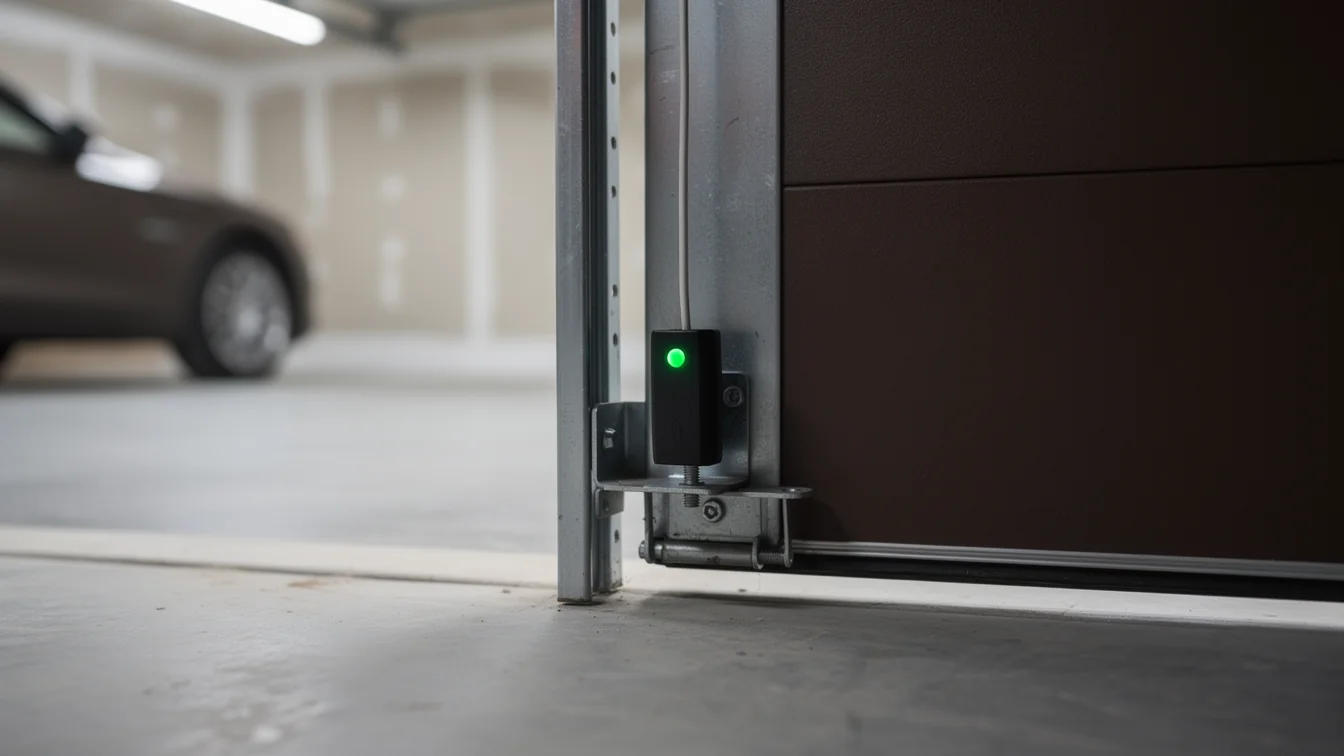
Some noises are worth a phone call right away. A loud bang from the spring area, especially paired with the door suddenly feeling heavy to lift by hand, means a torsion spring has likely broken - don't run the opener again until someone's looked at it. A grinding or metal-on-metal sound concentrated at one spot in the track, rather than along the whole run, usually means a bent section or a roller that's seized, and it won't fix itself.
Other noises can wait for a scheduled visit. A general squeak along the full travel of the door, consistent in both directions, is often just a lubrication issue on original hardware that's gone sixty years without much maintenance. A soft rattle in the opener chain or belt is worth mentioning but rarely urgent.
One honest limit here: we can't always tell which category a noise falls into over the phone. Hardware age and house era both matter, and with housing in this area running 1955 to 1984, we see a wide range of what's actually installed behind the trim. If you're not sure, describe when the noise happens - cold mornings, every cycle, only on close - and that narrows it down before a truck ever needs to roll.
What Is Going On
Underneath most of these noises is the same story: hardware installed decades ago, in a climate that stresses metal twice a year, finally showing its age. With over 39,700 owner-occupied houses across this service area, a large share of them sitting on original or early-replacement torsion systems from the 1960s and 70s building wave, the noises aren't random. They're the predictable result of that combination.
A median household income above $183,000 in this area means a lot of owners could replace a door outright without much thought, but replacement isn't always the right call. A healthy torsion spring system on a door that's otherwise sound is worth servicing, not scrapping. Where replacement does make sense is when the noise points to a track that's been bent and rebent, or a jamb that's shifted with the house over fifty-plus years - at that point, patching the symptom just delays the real job.
The noise itself is information. Loud and sudden points to a sprung or cable part letting go. Gradual and worsening with cold points to alignment or lubrication falling behind the age of the hardware. Either way, the sound came from somewhere specific, and that's where the fix has to happen.
Talk to a local pro
Garage door trouble in Stamford?
Same-day service with honest, upfront quotes.