
Strand fray failure mode
When one strand frays near the drum and lets go, the door doesn't just stop - it drops unevenly, cocks sideways in the track, and can bend a roller or pull the opposite cable off its drum groove in the same motion.
Stamford, CT
Frayed or snapped garage door cables are common in Stamford's 1960s-70s housing stock. Here's why this fault shows up here and what drives the repair.
Popular Services
Watch-outs
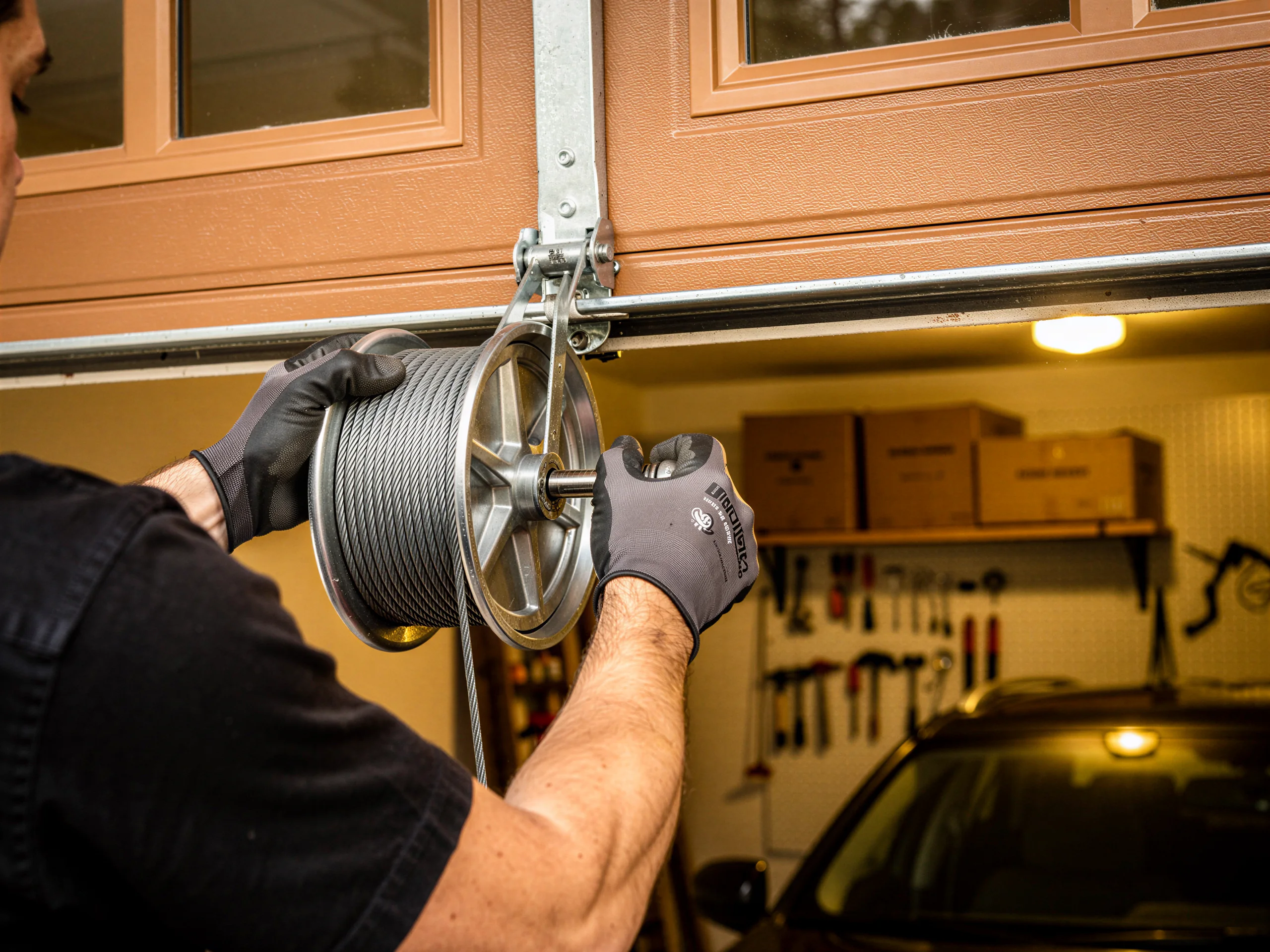
A cable job looks simple until the drum is involved. The lifting cable runs off a drum at the end of the torsion shaft, down through a pulley or stationary cone, and clips into the bottom bracket.
When one strand frays near the drum and lets go, the door doesn't just stop - it drops unevenly, cocks sideways in the track, and can bend a roller or pull the opposite cable off its drum groove in the same motion.
We see this most on double doors, where an uneven drop puts twisting load on the whole shaft and turns a cable swap into a shaft, drum, and bearing job. The other way it goes sideways: someone tries to wind it back by hand. A broken cable under spring tension is still under load on the opposite side, and a door that looks dead can still slam.
We don't recommend anyone but a trained tech touch a door with a snapped cable, and that's not a sales line - it's the actual failure mode. If the cable let go because the drum cone cracked or the shaft is bent, cable replacement alone won't hold, and that's a different repair.
Local causes
Stamford's housing is not evenly new or evenly old - most of it, across the 16 named sections from Cos Cob to North Stamford to Springdale, went up between 1955 and 1984, with a median build year of 1968. That's a lot of garages running original or first-generation replacement cable hardware that's now into its sixth decade of open-and-close cycles. Cable doesn't fail on a schedule; it fails on cycle count plus corrosion, and houses this age have both.
The climate side matters just as much. Stamford sits in a cold-severe band, which means the galvanized coating on a cable and the steel underneath go through real seasonal swings - brittle in winter cold, expanding and flexing in summer heat. A cable that's been fraying quietly for two seasons tends to let go on the first hard cold snap, right when the door is also heaviest from the added drag of cold grease in the hinges and track. That combination - older original hardware plus a real winter - is why this fault shows up here more than in a climate that stays mild year-round.
Pricing
We don't have a flat number to hand you here, because cable repair pricing depends on what's actually wrong once we're looking at the drum, shaft, and spring tension together.
What we can tell you is how the decision tends to go in this service area. With median household income across Stamford and the surrounding towns at $183,112, most owners here choose to replace both cables as a pair rather than fix one side and wait for the other to go - the labor to get the door open and under control is most of the job either way, so doing both at once avoids a second visit.
The bigger cost driver isn't the cable itself, it's what the cable took with it. If a frayed cable damaged a roller, bent a track section, or cracked a drum, that gets priced separately.
The honest limitation here: we can't quote a cable repair over the phone without knowing whether the drum and shaft came through clean, and anyone who quotes sight-unseen on a dropped door is guessing.
Warning signs
Cable failure rarely happens with no warning at all, even though it feels sudden. Before a full snap, you'll often hear a new click or tick as the door moves, see a slight sideways lean when it's halfway up, or notice one side of the door hanging a touch lower than the other when it's closed.
Fraying strands sometimes show as a thin wire poking out near the drum if you look closely - don't touch it, just note it. When it does go, the door usually drops hard on one side, stops mid-track, or won't move at all because the opener senses the imbalance and refuses to run.
On a two-car door, you might see the whole panel twist slightly, which is the shaft trying to turn on one side while the other side has lost its cable tension entirely.
Across the 60,329 households and 39,759 owner-occupied houses in this service area, this is one of the more common calls we get between late fall and early spring, which tracks with the cold-severe climate putting the most load on aging cable right when it's least flexible.
Questions
No. A broken cable means the door is no longer under controlled lift, even if the spring is still intact. The opposite side can still be under full tension, and the door can shift or drop further the moment you touch it. Leave the door where it is, don't force the opener, and call for someone to look at the drum and shaft before anything else moves.
Stamford's cold-severe climate band puts real stress on aging cable. Galvanized wire gets stiffer in cold weather, and a cable that's been quietly fraying for a season or two tends to give out on the first hard cold stretch, often combined with a heavier door from cold, thickened grease in the track and hinges.
It's possible to replace just the failed side, but most owners in this service area choose to do both at once. The cables are usually close in age and cycle count, so if one fraying, the other isn't far behind, and the labor to access the drum and shaft is most of the job regardless of which side you do.
Not necessarily. The cable system and the opener are separate - a snapped cable just means the opener loses the mechanical ability to lift the door. If the opener kept trying to run against resistance before the cable fully let go, that can strain the opener's gears, but that's a separate check from the cable repair itself.
Explore more
Ready when you are
Stamford Garage Door Pros repairs and installs garage doors, springs and openers in Stamford, CT and the surrounding area.